
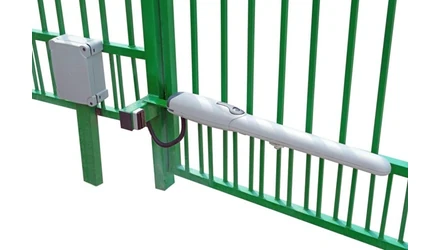
Regardless of the reason, many users eventually experience problems that could have been avoided during the planning and installation of a gate automation system.
In most cases, these issues are not caused by the electric gate motor or the barrier gate's mechanical components. Instead, they arise because the gate automation system is not properly matched to the property's specific requirements.
In this article, we present three common mistakes users make when installing a gate automation system and explain how to avoid them.
Mistake #1: The Same System Doesn't Work in Every Environment
Many people misunderstand what it means when an automatic gate system doesn't perform as expected.
It's not uncommon for the electrical installation to be flawless and the gate automation to function perfectly from a technical standpoint, yet the user is still dissatisfied.
The reason is simple: user requirements vary depending on the type of property, and today's market offers a wide range of solutions designed for different applications.
A common mistake is choosing a technology first and only later considering the characteristics of the environment where the system will actually be used.
This can easily be avoided by asking not only "How much does an automatic gate cost?" but also "How will the gate be used, and by how many people on a daily basis?"
What Questions Differentiate Gate Automation Systems?
These are just a few of the factors worth considering before choosing an automatic gate or gate automation system.
How Many People Will Use the System?
There's a significant difference between a system used by two family members and one shared by 30 residents.
Gate automation is also becoming increasingly popular in companies and institutions employing hundreds of people.
In these situations, a traditional remote-control solution is rarely sufficient.
Is Activity Logging Important?
A modern automatic gate is more than just an entrance—it also functions as an access control and security system capable of recording usage events.
This allows administrators to see exactly who opened or closed the gate, when it happened, and whether the user had the appropriate permissions.
These advanced features are particularly valuable for larger businesses and apartment buildings where security and access management are essential.
How Can Remote Access Be Provided?
One of the biggest differences between automatic gate systems is their operating range.
Electric gates controlled with conventional remote controls generally work only within a limited distance.
If long-range operation is required, radio-frequency remote controls alone may not be sufficient. That's why it's important to understand the available communication technologies.
What Makes One System Different from Another?
In many ways, gate automation operates according to the same principles as remote control systems. The key is understanding which communication technologies are required and how they differ from one another.
To transmit a command—such as opening a gate—the system requires a communication channel. This may use radio frequency, Bluetooth, an internet connection, or the mobile network.
As a result, the overall user experience often depends less on the gate's mechanical components and more on the quality and reliability of the communication technology.
How Can You Avoid This Mistake?
When selecting a gate automation system, carefully consider the installation environment, the number of users, the required operating range, and your access management needs.
The better the chosen technology matches real-world usage, the less likely users will have to compromise later due to the system's limitations.

Mobile-based gate control solutions are becoming increasingly popular for gate automation installations.
Mistake #2: Relying on Only One Communication Technology
The second most common mistake involves choosing the communication method. Many users settle for a single communication technology without considering which solution can provide the most reliable performance in their specific environment.
What Gate Control Technologies Are Available?
-
Gate control with a traditional remote control: In this case, the gate automation system is operated using a radio-frequency remote within a limited range. Each user requires their own remote control.
-
Bluetooth gate control: Here, the gate controller communicates with the user via a Bluetooth connection, typically through a smartphone.
-
IP/Wi-Fi gate controllers: One of the most popular forms of smartphone-based gate control, where commands are transmitted over an internet connection from the user's device to the gate controller.
-
GSM/4G communicators: GSM technology is particularly useful when long-range gate control is required or when upgrading older gate automation systems. ASC Global offers a wide range of GSM communicators for users who need reliable mobile network communication.
Of course, all of these systems can be enhanced with additional security features. However, the primary difference between them lies in the communication technology they use.
Many people assume that "everything works over the internet nowadays." As a result, they choose an IP-based gate controller without considering whether it is the best solution for the installation site.
IP and Wi-Fi systems work exceptionally well in residential properties with a stable internet connection. However, at remote locations, barrier gates, or industrial sites, internet connectivity cannot always be relied upon.
In these situations, an alternative or backup communication method is essential—and this should be considered during the planning stage.
In many cases, the best solution is a hybrid system, such as a GSM + Bluetooth or GSM + Wi-Fi backup configuration.
The main advantage of these combined systems is that they do not depend on a single communication channel. If one connection temporarily fails, the other can continue to provide access to the gate.
Mistake #3: Planning Only for Today's Requirements
Gate automation should be viewed as a long-term investment rather than a one-time purchase. Choosing a system based solely on current needs can lead to unnecessary costs in the future.
The challenge is that most systems work perfectly well when they are first installed and are suitable for the intended application.
However, over time, the number of users may increase, additional access permissions may be required, remote administration may become necessary, or event logging may become an important requirement.
Fortunately, these are needs that can often be anticipated during the initial installation. Many modern systems are expandable and can be upgraded with additional features as requirements evolve.
This allows the gate automation system to adapt to changing user needs without requiring a complete replacement.
In practice, this means that with a traditional remote-control system, even losing a single remote can become a significant inconvenience. Programming a replacement remote often requires on-site configuration, and remote administration is usually not available.
By contrast, a GSM gate controller uses phone-number-based authentication. Granting access to a new user simply requires authorizing their phone number. Remote configuration is also possible, and most GSM-based systems can be expanded with additional security features.
What's the Best Solution?
To avoid future limitations caused by wiring constraints or the restrictions of traditional remote controls, it's advisable to choose a scalable solution that supports:
-
Multiple users
-
Remote administration and programming
-
Event logging
-
Access permission management and modification
Several systems offer these capabilities, including the ASC Global MultiOne GSM Cloud and ProCon GSM/4G solutions.

Several gate automation systems are available to suit different requirements.
In Summary: Gate Automation Should Adapt to Its Environment
Gate automation is not just a single device—it is a complete system made up of several interconnected components. The real value lies in its communication capabilities, access management features, and future expandability.
Most user issues arise because the key characteristics of a reliable long-term solution are often overlooked.
A well-designed automatic gate system should fit its environment, provide stable communication, be easy to expand, and support additional security features whenever needed.
For this reason, it's worth considering the most suitable communication and access management technologies already during the planning phase to ensure reliable performance for years to come.
Contact the ASC Global team for expert advice in selecting the gate automation solution that best meets your requirements.