Why are 2G networks being shut down? – Reasons and trends for GSM module replacement
In recent years, the gradual shutdown of 2G networks, also known as the "2G sunset," has begun worldwide. This process is necessary because modern applications require faster, more reliable, and more energy-efficient networks.
A 4G-based GSM module not only significantly improves data transfer speed and network performance, but it can also be up to five times more energy-efficient than its 2G predecessor—making it a more future-proof investment.
Global trends show that the shutdown of 2G networks is actively underway, and many providers worldwide have already started or completed the phasing out of old systems. Therefore, transitioning to more modern technologies, such as 4G, is essential.
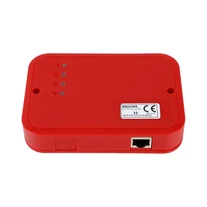
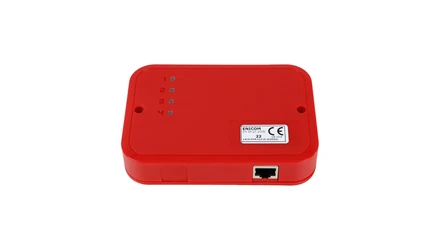
EniCom 4G module – dual SIM, cloud-based remote monitoring, and EN54-21 certification
The EniCom 4G modules were developed specifically for security and fire protection systems that require redundant signaling paths. The main communication channel is the Ethernet network, but a mobile network (LTE) can also be used as a backup. The device ensures data transfer using an IP-based protocol, guaranteeing a fast and reliable connection.
Main functions and applications of the Enicom 4G:
- Redundant data transfer: The EniCom 4G module handles two SIM cards, so if one provider is unavailable, it automatically connects to another network.
- Remote monitoring: The device can send messages via Ethernet or mobile internet networks to up to four different servers.
- Flexible configuration: Inputs are programmable for different loop types (NC/NO/EOL), and zone doubling is also possible.
- Remote control: Can be programmed and controlled remotely via a cloud connection.
- EN54-21 certification: An ideal choice for security and fire protection applications.
How do we jeopardize the operation of industrial and security systems if we don't switch to 4G?
The shutdown of 2G networks affects different systems in various ways. In many cases, it is critical for operators to switch to more modern solutions as soon as possible—this is the only way to maintain a remote monitoring or surveillance system. For these, a continuous data connection is not just a convenience feature but a fundamental requirement for operation.
In practice, this means that due to a communication error, alarms may be delayed, or complete data loss may occur.
Yet, there are many cases where the safety of a facility depends on the reliability of signal transmission. For instance, in the case of a fire alarm system, it is crucial that the alarm reaches the remote monitoring station as soon as possible.
Industrial automation is also a good example of the importance of a stable network connection. In industrial complexes and factories, where equipment and control units communicate via GSM modules, a stable connection directly influences the system's operation.
In the case of system integration, the risk increases further: if multiple subsystems are connected, the failure of a single communication point can trigger a chain reaction.
Why switch now if the 2G network is still available?
Many think that the shutdown of the 2G network will happen overnight. In reality, however, it is a longer process that affects users even in the period before the shutdown.
Providers are gradually decommissioning 2G, which degrades network quality. A 2G-based GSM module may still be functional, but due to network weaknesses, the usual stability of the communication channel is no longer guaranteed.
A 4G module, on the other hand, provides more modern data transfer, and the underlying network infrastructure is more reliable. Switching technology is not just about development; it is much more about maintaining the operational safety of existing systems.
Phase-out of EniCom 2G modules – when and why switch to 4G?
Due to the technological transition, EniCom 2G modules are only available upon special request. We recommend that our customers transition to EniCom 4G modules as soon as possible, as they offer more reliable long-term operation and a wider range of application possibilities.

If you have any further questions regarding the transition or our new products, we are at your disposal.