
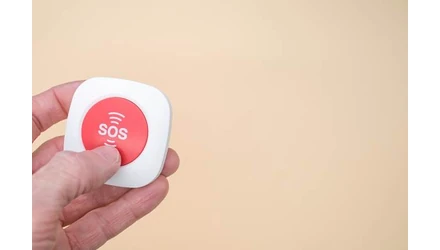
Thanks to remote monitoring systems, it is now possible to install emergency call devices not only in professional care facilities but also in private homes. Portable emergency callers for the elderly and patients are now widely available.
In this post, we show you everything you need to know about this technology, which can, in some cases, be life-saving.
The emergency caller: A fast connection to help
One might think that an emergency call device for the elderly is some sort of complicated "smart technology."
In reality, an emergency caller is not a "smart device" in the classical sense, but a targeted, easy-to-use safety device. At the same time, advanced electronics and communication technology work in the background to ensure reliable operation.
The goal of an emergency call device is to create a stable communication chain that can be relied upon at any time, regardless of external factors. The logic of the system is fundamentally the same as that of GSM-based alarm systems.
While not all models provide automatic alerts like standard alarm systems, some modern systems do offer automatic functions, such as fall detection or status reports. Typically, seniors can activate the alert simply by pressing a button, notifying family members or a remote monitoring station.
The operation of the home emergency caller in 4 steps:
- The user presses the emergency button.
- The central unit processes the signal.
- The central unit transmits the signal via a communication network.
- The distress signal arrives at the designated recipient.
Advanced models are also capable of establishing two-way voice communication, allowing the person in need to speak directly with the party receiving the emergency call—just like using a phone.
What does an emergency call system for the elderly look like?
It is easy to imagine an emergency call device, as it basically consists of three main elements.

Emergency call models possess various safety features.
What must be within reach: The push-button
This helps users send the signal. This is why portable push-buttons are important, allowing the emergency request to be made from different rooms in the house.
Today, the following are available:
- Necklace-style solutions – with a pendant-like design.
- Wristband versions – resembling a wristwatch.
- Fixed-mount versions – wall-mounted buttons, for example, in the hallway.
The most important part: The central unit
You could say this is the "brain" of the emergency call device. This unit is responsible for communication, i.e., signal transmission. If the push-button is not mobile, it connects directly to the central unit; otherwise, these two elements are connected wirelessly.
The third element: The communication channel
While not a "device" in the classical sense, it plays a key role. What distinguishes different signaling systems is the network through which they communicate.
Internet-based solutions exist, but many prefer GSM/4G systems. These devices provide data transmission via the mobile network. Systems operating on mobile networks offer a stable and widely available connection, as their functionality is primarily determined by network coverage.
Thus, the system does not depend on the home internet connection or WiFi signal strength. Some systems also send periodic test signals to verify that the connection is continuously functional—this increases operational safety.

A GSM emergency caller communicates via the mobile network.
What is needed to build GSM/4G systems?
One of the biggest advantages of this solution is its ease of use—which is especially important for the elderly. After installation, the system typically operates autonomously.
This technology requires a GSM or 4G communicator; as a central unit, this device provides mobile network communication. For this reason, GSM modules usually have their own SIM card to connect to the network.
ASC Global offers a wide range of communicators whose diverse parameters help the elderly live their daily lives more safely with the support of an emergency caller.
When is an emergency caller good? And when is it not?
It is important to understand the purposes for which an emergency call device can be used and the cases where installing such a system is not enough.
Some examples where a medical emergency caller is truly useful:
After a fall
It happens that an elderly relative gets dizzy while walking or slips in the bathtub. If they are in serious pain but conscious, they can send a notification to relatives or even health services using the emergency call device.
In case of sudden illness
Unexpected dizziness or a sudden drop in blood pressure can justify an emergency request; in such cases, a quick reaction is crucial.
In a panic situation
Situations can arise where a family member panics, for example, in the event of a technical malfunction or a fire. In such cases, immediate help is also needed.
What is the device not good for?
The emergency caller does not replace:
- Automatic health monitoring.
- Fall detection systems.
- Constant medical supervision.
It is important to know that the effectiveness of the emergency caller depends greatly on the user's ability to activate it and whether the device is within their reach during a critical situation. Although some systems are capable of automatic signaling, in most cases, only a conscious person can operate the emergency caller.
What should you look for when choosing an emergency caller?
Before setting up an emergency call system for the elderly, it is worth answering a few questions that will help determine the right technical solution. Of course, ASC Global staff will help you choose the emergency call device that meets your needs.
1. Is there adequate mobile network coverage?
This is essential for GSM technology to work. It is worth checking the signal strength inside the apartment, especially in basements, thick-walled buildings, or bathrooms.
2. Do you need a portable or fixed button?
Depending on the nature of use, it is worth choosing a device that is continuously accessible to the user.
3. Who will receive the alert?
You must determine who will receive the signal: a caregiver, a family member, or a dispatch service. Some systems can send alerts to up to eight phone numbers, even including a "round-robin" call function.
4. Is there backup power?
The central unit's power supply must be secured—ASC Global communicators use ProBattery to bridge power outages.
In addition to these, important factors include the wireless device's range and whether the emergency caller can be worn while showering.
Summary: A single button press is enough for real security
The greatest value of an emergency caller is that it shortens and simplifies the process of requesting help. That is why seniors like them: help is truly just a button press away. In certain situations, this can save lives.
ASC Global's solutions are built on GSM/4G-based communication systems that can provide a reliable foundation for setting up emergency call and alarm systems.
Check out our offers!