
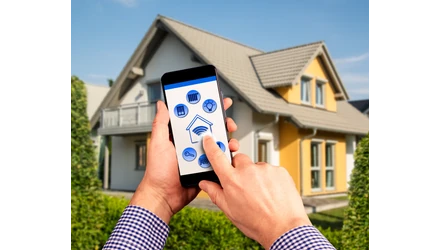
The significance of traditional remote controls is declining because they operate with limited range and more potential for error. Just think about the fact that switching a TV on or off can only be done within a few meters with these devices. And for opening and closing the garden gate, it is best if everyone in the family has a remote—which immediately increases the chance of someone losing it.
Modern remote control offers much more than this: it replaces stationary, complicated traditional systems and brings the possibility of control without physical presence.
In this post, we show you what you need to know about remote control in general and what the typical use cases are.
How is remote control different from a traditional remote?
Remote control manages a device through a mediator. The mediator can even be a computer; this is PC remote control.
A significant difference between the two solutions is that while PC remote control is based on the internet network and typically works with computer management, phone remote control sends signals via mobile networks using GSM modules.
Precisely for this reason, phone remote control is more widespread than computer remote control for residential purposes. Today, most users have a smartphone, so there are only a few places where the mobile network—the mediating medium for remote control—is unavailable.
Previously, 2G and 3G solutions were also popular, but in recent years, 4G technology has begun to displace earlier solutions.
The operating principle of PC remote control and phone remote control is practically the same. The user sends a signal via the mediator, and the command reaches a communicator or a remote control module through the network.
These pick up the signal and activate the device, meaning they open the gate or turn on the air conditioning.
Remote control does not "smarten" traditional devices; instead, it controls your home's electrical devices by installing a GSM gate opener module.
Let's see some examples of how remote control can be utilized!
This is how remote control can replace a gatekeeper!
With the development of electrical systems, more and more people have installed automatic gates at their garden entrances. These used to be controlled by traditional remotes, but they often ran out of battery, got lost, or simply broke down—within a short time.
Today, opening and closing entrance gates can also be solved with phone remote control. This can still be SMS remote control or WiFi remote control—here, the user's needs and the strength of the network signal are decisive.
The system allows signals to be sent from several different phone numbers. Thus, all members of the family, or in the case of corporate properties, employees, can send a signal to the communicator.
If desired, the remote control system checks the phone number from which the signal arrived. For authorized users, the communicator activates the device according to the command, for example, opening the gate by the time the user arrives.

With the help of remote control, garden gates, garage doors, and other electronic devices can be operated.
This solution makes it easier to let in a courier or a repairman, as there is no need to go out to them in the cold or rain. Of course, it also provides comfort if, after a long journey, the user wants to be welcomed home with open gates—in this case, they just have to call the communicator, which opens the gate by the time they arrive.
Remote control with a mobile phone also increases property security
Remote control also sends feedback when, for example, the user activates a device based on the communicator's signal. This approach is typically used in security technology solutions.
Traditional alarm systems signal locally. However, in the case of holiday homes or unused properties, it is rare for the owner to be nearby and hear the siren.
In contrast, alarm center signal forwarding happens via SMS, through an application, or by a call; the signal arrives on the user's phone if the alarm is triggered—whether it is a burglary or a fire protection system.
The user can then make a decision about turning off the alarm or taking security measures, such as notifying the authorities.
In these cases, GSM communicators or 4G signal forwarders excellently facilitate remote control, as they do not require an internet connection to operate. This can be relevant if the internet is weak near a rural warehouse or site, yet remote operation of the alarm system is still important.
Remote control is not a luxury, but a digital "caretaker"—smart homes prove this
Remote control via mobile phones and other devices has spread most widely in smart homes. In these properties, technology operation is automated using remote control, while elsewhere, things like heating or garden irrigation are managed manually.

Remote control with a mobile phone also automates garden irrigation.
Remote control is actually more than a luxury, because maintaining family houses is much more economical and energy-efficient than traditional properties. The reason for this is that with the help of remote control systems, the residential building's equipment can be operated at the right time and for the right duration—yet there is no need to stay home to look after the system.
What do you need to get for remote control installation?
For remote control, a phone alone is not enough, because communicators and remote control modules are needed for signal transmission. These have three functions.
They receive the signal arriving from the phone or the network. Following this, they interpret it, for example, determining if the signal arrived from an authorized phone number. After a successful check, they activate the command, thus putting electronic devices, lighting, or irrigation technology into operation.
Usage requirements determine what kind of communicator or remote signaler is needed. Customers can choose from several different modules in the ASC Global range; for example, ProCon GSM / 4G modules and MultiOne GSM / 4G communicators are excellent for remote control.

GSM modules and signalers required for remote control are available in the ASC Global range.
Communicators operating via mobile networks are also available in the ASC Global webshop. As a result, the modules have great coverage and can be controlled from anywhere with a call or via SMS.
Installing the modules is also simple; no complicated infrastructure is required, yet they ensure the remote control of several different devices. Communicators and remote control accessories create a system and do not function as separate devices.
Do you need remote control? – Answer these questions!
The popularity of smart homes is growing, and electronic devices are taking on a prominent role in more and more households—yet not everyone needs remote monitoring systems. A few simple questions will bring you closer to a decision: whether it is worth dealing with the introduction of remote control.
- Do you spend most of the day at home?
- Are you the only one who uses your home's electronic devices and accessories?
- Are you always confident that you have started the alarm system?
- etc.
These questions highlight the more important functions of remote control. Since many people answer "no" to these, it is worth looking at the possibilities offered by various communicators.
Visit the ASC Global webshop as soon as possible to find out what kind of remote control module you need!