
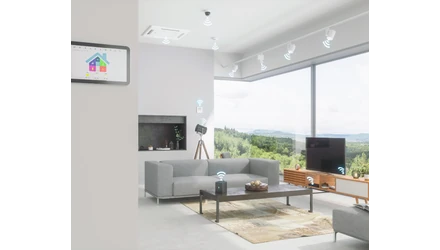
A huge variety of devices can be controlled even from greater distances – yet the underlying logic varies. When a traditional remote control runs out of power, someone loses it, or Internet-based remote control doesn't work due to a weak signal, many only face these limitations after the fact.
To repair, replace, or even build a new remote control system, you need to understand the differences between the solutions. Mobile control is used for one thing, for instance, while radio-based remote control operates on a different principle.
In this article, we will go through the differences between these two types of solutions and in what situations they are practical to use.
What is the difference between remote control technologies? It's not the device, but the communication that is key
When we think of remote control, we typically think of a specific device: an air conditioner or a remote-controlled helicopter. What these have in common is that the user can control them from a distance. Of course, this requires the appropriate technical background.
The basic logic of remote control is this simple:
In reality, the operation of remote control is much more complex. However, the basic principle can be outlined in three steps:
Step 1: The user sends a signal.
Step 2: The intermediary network transmits the signal.
Step 3: The communicator/reporting module receives the signal and executes the command.
Which step distinguishes the different technologies?
The difference between remote control technologies lies in the middle element of the process. The individual systems differ in their communication channels.
This also determines what technical parameters the various solutions have: range, security features, and expandability.
The different solutions can be grouped in several ways. One of the simplest categorizations is the distinction between radio-based remote control and mobile-based control systems.
Simply about how radio-based remote control works
Radio control, also known as radio-frequency technology, is one of the most basic wireless solutions for remote control. In this case, radio waves transmit the signal between the transmitter and the receiver.

A radio-based remote control is well-suited for the comfort of our home
The transmitter is usually a remote control, while the receiver is a device capable of receiving and processing the signal.
With this solution, additional devices such as reporting modules or communication modules are generally not needed, nor is a network.
How does a radio-based remote control work in practice?
The system operates on a specific frequency. If this is, for example, 433 MHz, the range of the remote control is typically between 20–100 meters.
What are the main advantages of the system?
Radio technology provides an immediate reaction. Furthermore, it is easy to install and cost-effective.
What disadvantages arise?
This solution only works within a limited range and is not suitable for managing multiple users. It also lacks security features such as event logging.
However, this simple solution works well in family homes, for example, for controlling gates or garage doors.
This solution is therefore ideal if the user is nearby.
The next level of remote control is when users want to control multiple devices from a greater distance.
What is mobile-based control good for?
Mobile control means that we can control different systems using our phone. However, the phone only acts as a control unit – this is not the essence of the system.
To understand the technology, the category of mobile remote control must be further broken down into: Internet-based systems and mobile network-based remote controls.
A few thoughts on the Internet solution
The transmitter and the receiver are connected by the Internet (WiFi/IP). This requires a communication module that receives and interprets the signals.
A stable Internet connection is required for the system to operate.
What should you know about GSM remote control?
This solution is also behind the operation of SIM card-based alarms. It can be used not only for alarm systems but also for gate opening or access control.
The basis of operation is the mobile network. A GSM remote control module is needed to receive and execute commands.
The biggest advantage of mobile control is that a given device, SIM card alarm, or even a doorbell can be controlled from almost anywhere. This solution is also suitable for managing multiple users and offers advanced security features.
One such feature is event logging, which is especially useful, for example, in the case of a SIM card alarm. Permission management is another popular security feature that comes in handy, for instance, in the case of doorphones.

A SIM card alarm works on the principle of mobile control
When is which solution appropriate?
These solutions respond to different needs. This means that knowing only the technical parameters is not enough to make a decision.
It is worth starting from the usage situation.
What is the goal? Do you just want to get through the gate?
For the most elementary home control of devices, the radio-based solution works perfectly. Moreover, this is the most cost-effective solution.
How many people will use it?
In the case of multiple users, mobile-based systems are more advantageous.
Do you need a long-range solution?
In the comfort of our home, radio technology may be satisfactory. However, from a greater distance, only IP or GSM remote control offers adequate service.
Is there a reliable Internet connection?
If higher performance is important but the Internet network is not available, then the mobile network may be the key; in such cases, a GSM system must be built.
Is extra security important?
For example, in the case of a SIM card alarm, the features of a mobile system help enhance the security of a facility or a family home.

These are the main differences between mobile-based control and radio-based remote control
How to think in terms of a system? – ASC Global helps
These questions help in making a decision, but expert support is needed to design a complete system.
ASC Global offers not only devices but complete remote control systems. These allow for the remote control of even several different types of devices, and are capable of gate opening, managing access control, and even operating the alarm.
This is not limited to family homes – more complex reporting modules also enable the monitoring of industrial sites and factory buildings. From long distances, for multiple users.
Our experienced professionals will help you choose the most appropriate control solution.
Summary: technology adapts to operation
A radio-based remote control is a local-level solution, while radio-based control is a complex system. When deciding, the question is not which technology is better, but in what situation it is used.
Visit the ASC Global webshop and get to know the different solutions.
Or check out our website, where further professional content will help you make your choice.